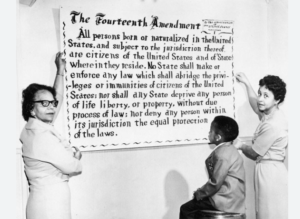
The Fourteenth Amendment was born out of the horrors of slavery and the betrayal that followed emancipation.
After the Civil War, the central question was: Would formerly enslaved Black people actually be citizens, or would Southern states be allowed to recreate slavery under another name?
The amendment answered that question directly. Its first sentence overturned the logic of Dred Scott, the Supreme Court decision that said Black people could not be U.S. citizens. The Fourteenth Amendment declared that all persons born or naturalized in the United States, and subject to its jurisdiction, are citizens of the United States and of the state where they live.
That was groundbreaking. It made citizenship national, not something states could give or take away. It also promised due process and equal protection of the laws, meaning states could not simply strip people of rights because they were Black, poor, immigrant, unpopular, or politically powerless.
But white supremacists fought it immediately. Southern states used terror, Black Codes, lynching, segregation, convict leasing, and voter suppression to gut Reconstruction. Later, courts helped hollow out parts of the amendment while protecting corporations more aggressively than Black citizens. Still, the Fourteenth Amendment became the backbone of modern civil-rights law.
And now, in our own time, that same citizenship clause is under attack again.
Trump’s January 20, 2025 executive order tried to deny birthright citizenship to children born in the United States if their parents were undocumented or only temporarily present. Courts blocked it, and on June 30, 2026, the Supreme Court struck it down as unconstitutional, holding that the order violated the Fourteenth Amendment. Trump said on July 8, 2026, that he would ask the Court to rehear the case.
So the July 9 anniversary is not dusty constitutional trivia. The Fourteenth Amendment was written to stop states and presidents from creating hereditary castes of people born here but denied belonging here. It was a Reconstruction weapon against racial exclusion. Today, the fight over birthright citizenship shows that the same old discriminatory issue is back on the table:
Who gets to be a full person under American law — and who gets pushed outside the circle?
Photo: Zinn Eduction Project
Share now