1989 — Huey P. Newton, co-founder of the Black Panther Party, is killed in Oakland
Huey P. Newton was one of the most important figures to emerge from the Black liberation movement of the 1960s. Born in Louisiana in 1942 and raised in Oakland, Newton graduated from high school barely able to read, then largely educated himself and eventually earned a doctorate in social philosophy from the University of California, Santa Cruz. While attending Merritt College, he met Bobby Seale, and in October 1966 the two founded the Black Panther Party for Self-Defense.
.
Newton and Seale believed the mainstream civil-rights movement had not adequately confronted the poverty, police brutality and economic exploitation experienced in Black urban communities. Their Ten-Point Program demanded employment, decent housing, meaningful education, an end to police brutality, fair trials and, fundamentally, Black people’s power to determine the future of their own communities. Politically, the Panthers combined Black liberation with socialism, anti-capitalism and opposition to American imperialism.
.
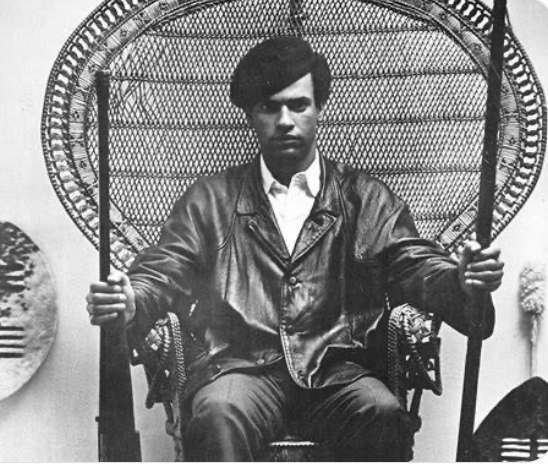
Newton became particularly associated with the Panthers’ doctrine of armed self-defense. Panthers legally carried firearms while observing Oakland police encounters, intending both to document police behavior and deter brutality. The famous 1967 photograph of Newton seated in a wicker chair holding a rifle and spear—the first photograph above—became one of the defining images of Black Power.
.
But guns were only one part of what Newton and the Panthers built. The Party developed what it called “survival programs”: free breakfasts for schoolchildren, food distribution, medical clinics, sickle-cell testing, political education and other community services. Newton increasingly argued that revolutionary politics had to address people’s immediate material needs rather than merely promise liberation sometime in the future.
.
That combination of revolutionary politics, armed resistance and rapidly growing community support made the Panthers a major target of J. Edgar Hoover’s FBI and COINTELPRO. Hoover publicly characterized the Panthers as an extraordinary domestic threat. FBI operations went considerably beyond surveillance: COINTELPRO explicitly sought to disrupt, discredit, misdirect and neutralize Black liberation organizations. Of 295 documented COINTELPRO actions directed against Black nationalist organizations, PBS’s account of the FBI records says 233 targeted the Black Panther Party.
.
The FBI planted informants, spread disinformation and exploited existing rivalries. Newton himself later argued that COINTELPRO helped deepen the disastrous split between his faction and Eldridge Cleaver’s through forged communications and other manipulation. The repression was sometimes lethal: Chicago Panther leader Fred Hampton was killed during a 1969 police raid, an episode that became inseparable from the history of federal infiltration of the Panthers.
.
In the early morning of August 22, 1989, Newton was shot to death on a street in West Oakland. He was 47 years old. Tyrone Robinson, a drug dealer associated with the Black Guerrilla Family, was subsequently convicted of murdering him and sentenced to 32 years to life. Newton therefore was not killed by COINTELPRO or the police, and it would be misleading to say that he was.
.
The connection to COINTELPRO is broader and historically important. Newton died after a movement he helped create had endured two decades of police repression, prosecutions, infiltration, imprisonment, internal warfare and deliberate federal attempts to destroy its cohesion. COINTELPRO did not pull the trigger that killed Huey Newton in 1989. It did, however, wage a documented campaign against Newton’s movement during the years when the Black Panther Party was at the height of its power.
.
Newton’s enduring achievement was helping transform the politics of Black Power from a demand merely for inclusion into a much more radical argument about who controls the police, the economy and the institutions governing everyday life. The Panthers insisted that freedom also meant food, housing, medical care, education and protection from state violence. More than half a century later, those demands make their Ten-Point Program feel remarkably contemporary.
Share now