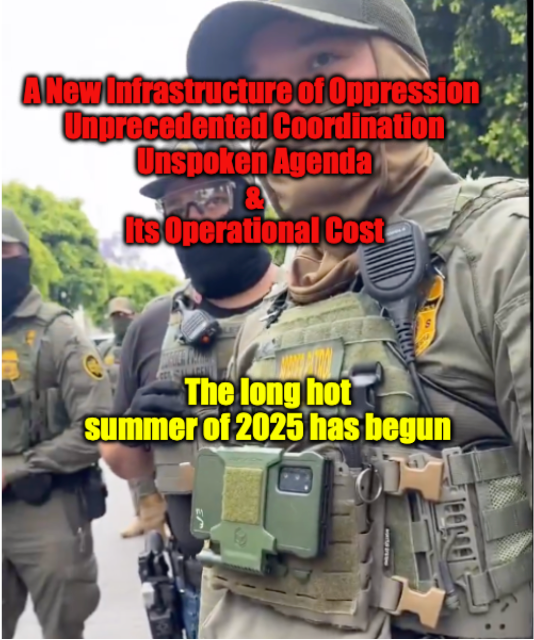
The 2025 ICE raids and resulting wave of protests have revealed what may be the most extensive and deeply integrated law enforcement mobilization in U.S. domestic history—synchronized operations involving local police departments, state troopers, sheriff’s offices, National Guard units, and a full range of federal agencies from ICE and DHS to ATF, FEMA, and even the military under Title 10 activation.
Not even in the aftermath of 9/11, when national security imperatives were at their peak, did the country witness this level of seamless coordination between city cops, county sheriffs, federal deportation officers, riot police, and military backup. The connective tissue—real-time surveillance, rapid interagency deployment, and operational overlap—suggests this was more than a law enforcement surge.
Test run of a fully networked domestic control system?
Trump’s language—like “round them all up”—paired with the use of military riot tactics against protestors, reflects an openly hostile posture toward immigrants that goes beyond policy into deliberate provocation and psychological warfare. The targets—immigrants and protestors—serve a dual purpose: as scapegoats and as cover for a far broader agenda.
This appears to be less about immigration enforcement and more about a calculated practice deployment of a fully integrated police state seamlessly connecting federal, state and local law enforcement with military, complete with crowd control, rapid escalation capacity, and legal ambiguity. The scale, speed, and aggressiveness of the response point to a dress rehearsal for future unrest—either anticipated economic collapse, diversion from possible pending global military events, or domestic uprisings linked to escalating global wars. The failure of Trump’s immigration bill, the tariff fallout, and two active war fronts (involving Russia and Iran) all provide motive for a distraction. The public spectacle of raids and rebellion offers a smoke screen.
What exactly are they preparing for?
This is no longer about law and order. It’s the infrastructure of suppression, built in plain sight.

Source: @PplsCityCouncil
“You round them all up in a very humane way, in a very nice way, and they’re gonna be happy.”
President Donald J. Trump, 2025
Law Enforcement Infrastructure
A consolidated list of all federal, state, and local agencies that have been involved in deportation operations and riot control in connection with the 2025 ICE raids and related protests:
Federal Agencies
U.S. Immigration and Customs Enforcement (ICE)
Enforcement and Removal Operations (ERO) — subdivision of ICE
U.S. Department of Homeland Security (DHS)
U.S. Border Patrol (under Customs and Border Protection)
Federal Emergency Management Agency (FEMA)
Bureau of Alcohol, Tobacco, Firearms and Explosives (ATF)
Federal Bureau of Investigation (FBI)
U.S. Marshals Service
Department of Justice (DOJ)
Department of Defense (DOD) — operational command for military personnel
U.S. Northern Command (USNORTHCOM) — for National Guard deployment under federal authority
Office of Refugee Resettlement (HHS) — secondary role in removals involving minors
Federal Protective Service (FPS) — deployed to protect federal buildings during unrest
Source: @PplsCityCouncil
State Agencies
California National Guard
Texas Department of Public Safety (DPS)
Florida Department of Law Enforcement (FDLE)
Georgia State Patrol
Illinois State Police
Tennessee Highway Patrol
Arizona Department of Public Safety
(Each state deploying officers or troopers in response to local protests or supporting ICE arrests)
Local and Municipal Agencies
Los Angeles Police Department (LAPD)
Los Angeles County Sheriff’s Department
New York Police Department (NYPD)
Chicago Police Department
Houston Police Department
Miami-Dade Police Department
Phoenix Police Department
San Diego Police Department
San Francisco Police Department
Denver Police Department
Portland Police Bureau
Seattle Police Department
Dallas Police Department
These and others assisted with protests, street lockdowns, or ICE coordination depending on region.

Source: @PplsCityCouncil
Projected Cost of Deporting 15-20 Million Undocumented Residents, the Goal Stated by President Trump in 2025
To estimate the cost of ICE arrests and deportations, we took a look at the numbers available for the first 100 days of Trump’s second term. ICE totaled 66,463 arrests—averaging 665 per day.
In order to fulfill President Trump’s stated goal of “roundin’em all up” at the current ICE raid and deportation rate and known cost of the desired figure of 15 to 20 million in deportations, it will take a median of 63 to 84 years and $1.5 to $2 trillion to complete the job.
Here’s a breakdown of the estimated cost per person in ICE enforcement and deportation, based on currently available data. We will detail what we know, what is uncertain, and provide cost projections based upon current numbers of the full current cost to deport 15 to 20 million people.
Known Basic Cost per Person on the Federal Budget
Arrest + detention + removal (averaging $17,121)
DHS reports an average cost of $17,121 to arrest, detain, and remove each undocumented person.
Deportation Removal Flight Cost
Air removal flights average $17,000/hour
Typical ground removal (e.g. to Mexico) costs about $1,479 per person
Detention costs per day
Private detention: $148–$164 per person/day
Federal detention median: $150 per night with ~46-day average stay for deportees
Family residential center: $296 per person/day
Infrastructure Costs
Detention facility build-out and operations: $66 billion annually for 1M removals ($7,000 per person)
Mass deportation event cost for 11 million estimated at $24 billion ($2,200 per person)—but excludes fixed significant construction costs.
Consolidated Cost per Person
| Component | Estimated Cost |
| Arrest, hold, remove | $17,121 |
| Ground transportation | $1,479 |
| Legal process (court) | $10,854 |
| Detention ( avg. 46 days) | $7,000 – $7,500 |
| Infrastructure & support | $7,000 – $66,000 |
Minimum baseline: $17,121 + $1,479 = $18,600 (basic enforcement + transport)
With legal proceedings: + $10,854 = $29,500
With detention: + $7,000 = $36,500
With scalable infrastructure costs: could drive total to > $100,000 per person
Projected cost for 15–20 million people, as stated by President Trump
Baseline ($18.6k/person):
15–20 M × $18,600, estimated cost: $279–$372 billion
Average case ($36.5k/person — enforcement + court + detention):
15–20 M × $36,500 approx. $547.5–$730 billion
Full-scale operation (> $100k/person):
15–20 M × $100,000 = $1.5–$2 trillion
What’s Unknown and/or Variable
Length of detention varies widely—could fluctuate by case severity, staffing, and legal backlog.
Country-specific removal costs—some flights cost up to $250k per flight
Home-country cooperation—if countries reject return flights, costs rise significantly (e.g., $20k per person found in Venezuela/El Salvador cases)
Legal backlog and court hiring—large-scale operations require massive judicial expansion.
Infrastructure bursts—building detention capacity in compressed time increases costs disproportionately.
Summary
Best-estimate per person (common case): $30,000–$40,000
Minimum (excluding detention and courts): $18,600
Maximum threat (full scale): > $100,000
Projected total cost to deport 3 million people:
• Baseline: $55.8 billion
• Realistic middle: $109.5 billion
• Full-scale with rapid build-out: $300 billion+
Enforcement and transport alone cost nearly $20k per person.
Adding detention and legal proceedings brings it to around $30–40k.
Building out infrastructure for mass removal inflates costs dramatically.
Smaller efficiencies (like voluntary self-deportation) could save up to 70% per case.
Cost Categories Omitted from Deportation Projections – Cops, Cops and Cops
These expenses are not included in the deportation cost analyses:
Overtime wages and shift premiums for LAPD and Sheriff’s deputies.
Equipment utilization: tear gas, grenades, shields, vehicles.
Guard/Civilian deployment costs: pay, transport, lodging, meals for 2,000+ troops.
Command infrastructure: setting up coordination centers and interagency command posts.
Property damage reimbursement and cleanup (e.g. burned cars, graffiti).
Legal claims: potential lawsuits from false arrests or excessive force.
Medical care for protesters or injured officers.
Public transit disruptions and economic impact of street closures.
Expected Timeline for Cost Reporting for Los Angeles June 2025 ICE-Related Costs
Mejia’s office promised to release detailed cost breakdowns once the LAPD responds to audit requests.
As of now (June 8, 2025), no figures have been released. We expect an initial estimate within 2–4 weeks following Controller audit protocols.
Controller Mejia (#LAControllerMejia) has actively begun tracking LAPD protest-related spending—but no dollar figures have been disclosed yet.
National Guard and federal deployment add a significant, unrecorded expense.
All these ancillary costs are excluded from existing per-person deportation estimates.
Action pending: important to watch for Mejia’s upcoming report to properly quantify the full financial footprint of the protests and enforcement response.

Source: @PplsCityCouncil
SOURCE LINKS
https://www.theguardian.com/us-news/2025/jun/05/trump-ice-arrests-immigration
https://apnews.com/article/4fa874908a64b12f1b1ee0be3825fb39
https://nypost.com/2025/05/28/us-news/trump-aid-stephen-miller-pushes-ice-to-arrest-3000-per-day-report
https://www.washingtonpost.com/nation/2025/06/08/los-angeles-protests-immigration-raids-ice
https://www.theguardian.com/us-news/2025/jun/06/los-angeles-ice-raids-immigration
https://apnews.com/article/f8c4160e32be0ff77c5d4bf0ccef98cc
https://www.ice.gov/doclib/about/offices/ero/pdf/eroFY2016Report.pdf
https://www.npr.org/2025/05/29/politics/immigration-court-backlog-surges-after-new-round-of-raids
https://www.dhs.gov/sites/default/files/publications/Immigration-Enforcement-FY2016.pdf
https://www.cato.org/blog/how-much-would-it-cost-deport-immigrants
https://www.nbcnews.com/news/latino/how-much-would-it-cost-deport-11-million-immigrants-rcna134561
https://www.migrationpolicy.org/news/mass-immigration-enforcement-costs
https://www.gao.gov/assets/gao-15-153.pdf
https://www.nytimes.com/2025/06/06/us/los-angeles-immigration-protests.html
https://twitter.com/LACityController/status/1799511504721201235
https://www.kcrw.com/news/shows/press-play-with-madeleine-brand/trump-ice-deportation-protests-la-police-costs/controller-kenneth-mejia-interview
https://en.wikipedia.org/wiki/Activist_deportations_in_the_second_Trump_presidency