8/23/1917: The Houston Uprising – Black Soldiers Fight Back Against
Jim Crow Policing. The Army later executed 19 of them.
PHOTO:
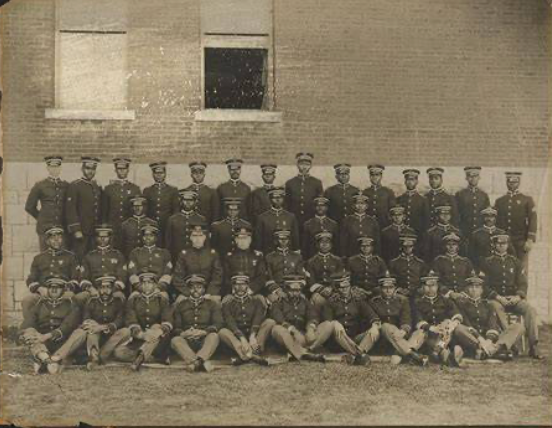
Members of Company I, U.S. Army 24th Infantry Regiment, circa 1900. The 24th was one of the Army’s historically Black regiments. Soldiers of its 3rd Battalion were stationed at Camp Logan in Houston in 1917.
Library of Congress, William A. Gladstone Collection of African American Photographs.
The Houston Uprising
On the night of August 23, 1917, Black soldiers stationed in Houston did something dangerous in the Jim Crow South: after months of racial harassment and escalating violence by white police, more than 100 soldiers of the 3rd Battalion, 24th Infantry Regiment took up their Army rifles and marched into the city.
The event entered American history as the Houston Riot of 1917, or the Camp Logan Mutiny. The violence grew out of the collision between armed Black American soldiers wearing the uniform of their country and a segregated city in which white authorities expected Black people to submit to racial domination.
Black soldiers in Jim Crow Houston
The 24th Infantry was one of the Army’s historically Black regiments, whose members became popularly known as Buffalo Soldiers. In 1917, its 3rd Battalion was sent to Houston to guard construction of Camp Logan, a military training installation being built as the United States mobilized for World War I.
The soldiers arrived in a city rigidly divided by Jim Crow.
Houston’s police force was overwhelmingly white, and Black residents lived under segregation backed not simply by custom but by police power and the threat of racial violence. The Black soldiers encountered racial slurs, discriminatory treatment and repeated confrontations with local whites and police. Army historians now describe the Houston confrontation as rooted in segregation maintained through prejudice, the legal system, mob violence and lynching.
The uniform offered no protection. Black soldiers serving the United States could still be assaulted and humiliated by white civilians and police.
The confrontation that ignited the uprising
The immediate crisis came on August 23. Houston police were attempting to arrest a Black woman when a Black soldier intervened. He, too, was arrested. Corporal Charles Baltimore, a member of the military police, went to investigate what had happened.
Instead, Baltimore himself was beaten by a Houston police officer, shot at as he fled and taken into custody. Back at Camp Logan, word spread that Baltimore had been killed.
This was untrue but the soldiers had little reason to dismiss the possibility. Against the background of months of hostility and the very real racial violence surrounding them, rumors also circulated that an armed white mob might be coming for the camp.
The situation exploded.
More than 100 armed Black soldiers (accounts commonly put the number around 150) seized rifles and ammunition and left Camp Logan, marching toward Houston.
Gunfire and chaotic confrontations followed.
By the end of the night, 19 people were dead, according to the Army’s modern accounting, including Black soldiers, Houston police officers and civilians.
The uprising was over within hours.
The punishment would last for decades.
The largest mass courts-martial in U.S. Army history
The Army arrested scores of Black soldiers and eventually prosecuted 118 men in three mass courts-martial. The proceedings were extraordinary. Dozens of defendants were tried simultaneously. Questions later arose about eyewitness identifications, representation of defendants, evidence and the ability to determine individual responsibility during the confused nighttime violence.
The first trial produced an especially horrifying result.
Thirteen Black soldiers were sentenced to death.
There was no meaningful opportunity for appeal before the sentences were carried out.
Before dawn on December 11, 1917, the Army transported the condemned soldiers to a scaffold near San Antonio and hanged all 13 men in secrecy.
Their families had not even been informed beforehand.
Six more soldiers were subsequently executed, bringing the total to 19 — the largest mass execution of American soldiers by the U.S. Army.
Dozens of others received lengthy prison sentences.
The executions themselves caused such alarm that the Army immediately changed its rules: future military death sentences could not be carried out without review by the War Department and the president.
The men executed at Houston therefore helped produce greater procedural protections for future soldiers — protections that had come too late to save them.
The NAACP fought for the imprisoned soldiers
The case became an important early campaign for the NAACP.
The organization challenged the treatment of the 24th Infantry soldiers and spent years seeking clemency for those still imprisoned.
In 1924, an NAACP delegation led by James Weldon Johnson delivered a petition bearing approximately 125,000 signatures to President Calvin Coolidge asking for pardons for the remaining prisoners.
Sentences were reduced and prisoners gradually released.
The final imprisoned soldiers were freed under President Franklin D. Roosevelt in 1938 — more than twenty years after the uprising.
But their convictions remained.
106 years later, the Army admitted the trials were fundamentally unfair
Then, in November 2023, the U.S. Army took an extraordinary step.
After reviewing the original proceedings, the Army Board for Correction of Military Records unanimously concluded that serious deficiencies had permeated the trials and that the proceedings were fundamentally unfair.
Secretary of the Army Christine Wormuth ordered the convictions of all 110 soldiers who had been convicted set aside.
Their military records were corrected, as far as possible, to characterize their service as honorable.
The Army explicitly acknowledged race as central to the injustice, concluding that the soldiers had been wrongly treated because they were Black and had not received fair trials.
It took 106 years.
The decision could not return the lives of the 19 men the Army had hanged. But it radically changed the official record. Men whom the government had labeled mutineers and criminals for more than a century were formally recognized as victims of an unjust military legal process operating inside the racial order of Jim Crow America.
The Houston uprising does not fit neatly into a story of peaceful resistance followed by inevitable progress.
These were armed Black men who had been asked to serve a country that denied them equal citizenship.
They wore United States Army uniforms while being subjected to the same racial hierarchy confronting other Black Americans. When police violence and rumors of further attack convinced some of them that neither local authorities nor the Army would protect them, they took their weapons and resisted.
People died who had played no role in the abuse of the soldiers, and the violence of that night cannot simply be reduced to heroism.
Neither, however, can the event be understood without the system that preceded it.
The Army itself now acknowledges the racial provocations and police violence that formed its background and that the justice subsequently imposed upon the Black soldiers was profoundly unequal.
For more than a century, the government preserved the convictions.