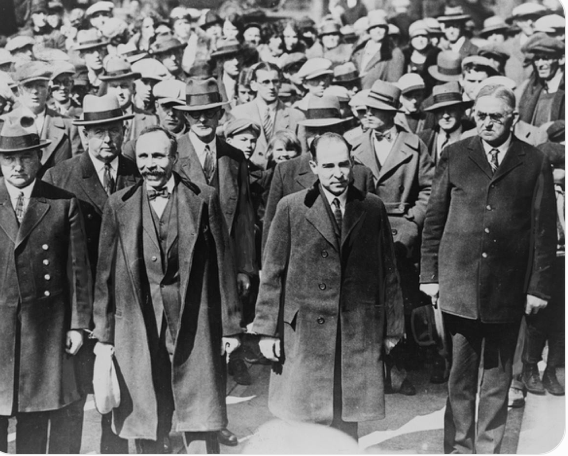
after a trial marked by Red Scare, anti-immigrant hatred and hostility to leftists. Their deaths sparked outrage around the world.
August 23, 1927, Sacco and Vanzetti: Anarchists, Immigrants and the Machinery of the Red Scare
Shortly after midnight on August 23, 1927, Massachusetts strapped two Italian immigrant workers, Nicola Sacco and Bartolomeo Vanzetti, into the electric chair at Charlestown State Prison. Their executions ended one of the most bitterly contested criminal cases in American history.
Sacco was a skilled shoeworker. Vanzetti sold fish. Both were immigrants from Italy, working-class men and committed anarchists. And they were prosecuted at precisely the moment when the United States was gripped by the First Red Scare — an era of raids, deportations and government repression directed against anarchists, socialists, labor militants and other radicals.
Whether Sacco and Vanzetti were guilty of the murders for which they were convicted remains debated. What became increasingly difficult to dispute was that their politics, nationality and immigrant status had become inseparable from their prosecution.
Two immigrant workers become defendants
Both men arrived in the United States from Italy in 1908.
Sacco eventually found relatively steady employment in a Massachusetts shoe factory and started a family. Vanzetti moved through a succession of difficult jobs before making a living selling fish.
They also became part of the militant Italian-American anarchist movement.
Their politics were unapologetically revolutionary. They opposed capitalism, nationalism and war and belonged to an anarchist milieu that viewed governments and concentrated economic power as systems of coercion.
That made them dangerous men in the eyes of the American government.
Following the Russian Revolution and a wave of strikes and bombings, the United States entered the Red Scare of 1919–1920. Attorney General A. Mitchell Palmer’s Justice Department conducted mass raids against radicals. Thousands were arrested. Immigrants suspected of revolutionary politics were targeted for deportation.
It was in this atmosphere that Sacco and Vanzetti were arrested.
The South Braintree murders
On April 15, 1920, two employees of a shoe company carrying payroll money were attacked in South Braintree, Massachusetts.
Paymaster Frederick Parmenter and guard Alessandro Berardelli were shot and killed, and the attackers escaped with roughly $15,000.
Several weeks later police arrested Sacco and Vanzetti.
The prosecution argued that the two anarchists had participated in the robbery and murders.
The defense insisted they had not.
From there, what might otherwise have been a Massachusetts murder prosecution became something much larger.
Anarchism itself entered the courtroom
Sacco and Vanzetti’s political beliefs became a major presence at their trial.
They were questioned about anarchism, their opposition to World War I and their decision to leave the United States for Mexico during the wartime draft.
The atmosphere mattered.
These were not simply two defendants accused of murder. They were Italian immigrants and anarchists standing before an American jury during one of the country’s most intense periods of anti-radical and anti-immigrant hysteria.
Massachusetts’s own historical presentation of the case now places it squarely in that environment, discussing the Red Scare, prejudice against Italian immigrants and the civil-liberties questions surrounding the prosecution.
On July 14, 1921, both men were convicted of murder.
They were sentenced to death.
A Massachusetts murder case becomes a worldwide cause
Instead of disappearing into the prison system, Sacco and Vanzetti became internationally famous.
For the next six years, their supporters fought to overturn the convictions.
Questions accumulated about witnesses, ballistics evidence, the conduct of the trial and the openly hostile attitude attributed to trial judge Webster Thayer toward radicals.
Then another man complicated the case even further.
Portuguese immigrant Celestino Madeiros, already facing execution for another murder, confessed that he had participated in the South Braintree robbery with members of a criminal gang and said Sacco and Vanzetti had not been involved.
The confession became the basis for another demand for a new trial.
It failed.
By then, the names Sacco and Vanzetti had traveled far beyond Massachusetts.
Workers, anarchists, socialists, writers, artists and civil-liberties advocates organized on their behalf.
Demonstrations erupted across the United States and abroad.
August 23, 1927
As their executions approached, demonstrations intensified.
The Library of Congress preserves photographs of enormous Sacco-Vanzetti demonstrations, including protests in New York City on the very day of their execution.
There would be no reprieve.
At Charlestown State Prison shortly after midnight, Nicola Sacco was electrocuted first.
Bartolomeo Vanzetti followed.
A third prisoner, Celestino Madeiros, was also executed that night for an unrelated murder.
Outside the prison and across the world, people waited for news.
The deaths provoked demonstrations internationally.
Five days later, an enormous funeral procession carried Sacco and Vanzetti through Boston. Massachusetts’s own archival history preserves photographs of crowds filling the streets.
Their execution had transformed two immigrant laborers into international political symbols.
Vanzetti himself understood the strange transformation.
He argued before his death that without the prosecution, he and Sacco would have lived and died as obscure working men.
Instead, persecution had made their names known around the world.
That was precisely what happened.
Their faces appeared on posters and banners. Their names entered labor history, immigrant history and the history of American civil liberties. Writers and artists returned repeatedly to the case.
For generations of radicals, Sacco and Vanzetti became shorthand for class justice: the belief that courts operating within deeply unequal societies cannot always be separated from the political and economic power surrounding them.
Massachusetts finally acknowledged the injustice surrounding the case
Fifty years later, Massachusetts returned to the controversy.
In 1977, Governor Michael Dukakis issued a proclamation declaring August 23 Nicola Sacco and Bartolomeo Vanzetti Memorial Day.
Dukakis did not formally declare the men innocent.
Instead, he stated that the atmosphere surrounding their trial and appeals had been contaminated by prejudice against foreigners and hostility toward unconventional political views, and that the stigma attached to their names should be removed.
That distinction matters.
There has never been universal agreement about who fired the shots at South Braintree. Historians and forensic researchers have continued arguing about aspects of the physical evidence.
But the historical significance of Sacco and Vanzetti extends beyond solving the crime.
Their case asks a more disturbing question:
What happens when a criminal trial takes place inside a society already convinced that people like the defendants are enemies?
Sacco and Vanzetti were Italian during an era of vicious anti-Italian prejudice.
They were immigrants during an era of xenophobia.
They were anarchists during the Red Scare.
They were working-class radicals at a moment when strikes, revolution and organized labor terrified much of America’s political and business establishment.
And Massachusetts killed them.
PHOTO: Bartolomeo Vanzetti and Nicola Sacco outside the courthouse in Dedham, Massachusetts, 1927. Period photograph.
Share now