Black Soldiers Refuse to Police Black America
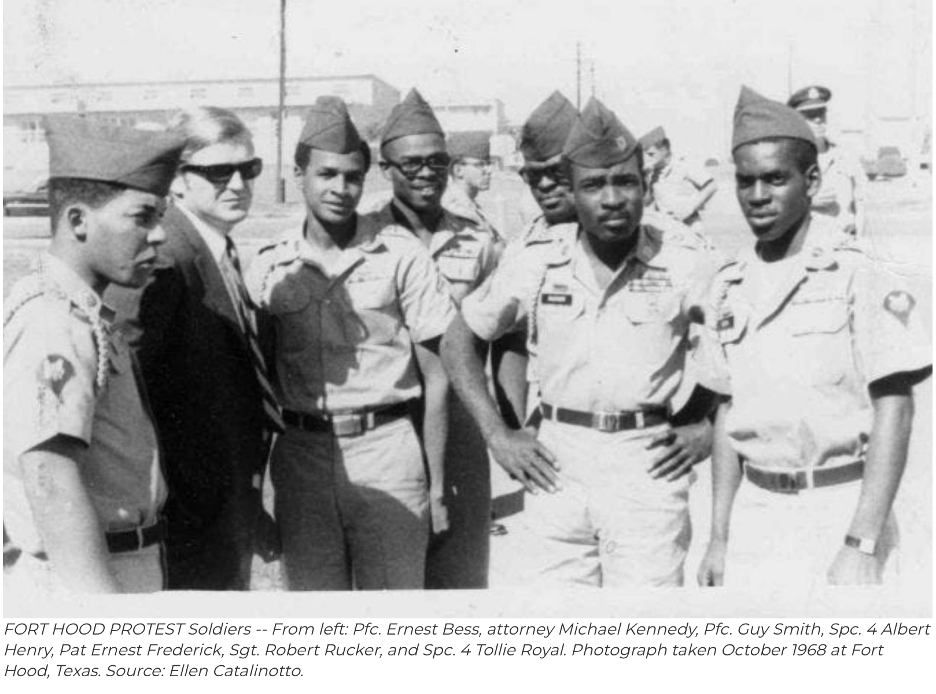
On August 23, 1968, more than 100 Black U.S. soldiers gathered at Fort Hood, Texas, to confront the Army that had ordered them into an American city to suppress people whose experiences of racism they shared. For 43 soldiers, the answer became no.
Their protest, remembered as the Fort Hood 43, became one of the largest acts of military civil disobedience of the Vietnam era and a remarkable intersection of the Black freedom struggle, opposition to the Vietnam War and growing rebellion inside the U.S. military.
America in 1968
The country was already in upheaval. Martin Luther King Jr. had been assassinated in April. Robert Kennedy was assassinated in June. The Vietnam War was consuming American lives while opposition to it grew increasingly militant.
Black Americans were simultaneously confronting segregation, police brutality, poverty and discrimination including inside the armed forces.
After King’s assassination, thousands of federal troops had already been deployed domestically as rebellions erupted in American cities.
The Democratic National Convention was scheduled to open in Chicago on August 26. Thousands of antiwar demonstrators were expected, and authorities assembled an enormous security force.
Chicago police would be joined by approximately 5,000 Illinois National Guardsmen and 6,500 federal troops.
Among the soldiers preparing for possible deployment were men stationed at Fort Hood.
For some of its Black soldiers, the assignment presented a profound moral problem.
“Our own race”
Many Black GIs had already experienced racism inside the Army. Some were Vietnam veterans. Some had been wounded in combat.
Now they faced the possibility of returning from fighting overseas only to be deployed against Black Americans at home.
On the evening of August 23, more than 100 Black soldiers gathered at Fort Hood to discuss their grievances and the impending Chicago deployment.
Around midnight, approximately 60 soldiers sat down at a major intersection on the base.
Their demonstration was peaceful.
They talked about racism in the Army, conditions facing Black Americans and whether they should obey orders sending them into Chicago.
One soldier summarized the dilemma starkly: the people they might be ordered to control would probably be members of their own race.
Another expressed the principle even more directly: they had obeyed the Army and served their country, but they did not believe they should be required to treat fellow Americans as enemies.
For Black soldiers in 1968, the contradiction was impossible to miss. America was asking them to defend democracy abroad while Black Americans were fighting for basic equality at home.
The Army demands that they disperse
The sit-in continued through the night. At approximately 5 a.m., Major General John C. Boles Jr., commander of the 1st Armored Division, and members of his staff met with the soldiers.
Military commanders urged them to end their protest.
Seventeen eventually left.
Forty-three remained.
Those 43 men were detained.
Their number became their name.
The Fort Hood 43
The Army treated the protest as a serious breach of military discipline. Many of the soldiers faced courts-martial. Some were reduced in rank. Others received sentences that included confinement and hard labor. But the soldiers had exposed a political contradiction extending far beyond one Texas military base. Black Americans were disproportionately represented among combat troops fighting in Vietnam during important years of the war. They were expected to obey military authority overseas while their families and communities continued confronting racial discrimination and police violence at home. For some Black servicemen, the civil-rights and antiwar struggles therefore became inseparable.
Only days later, the Democratic National Convention opened. The violence that followed became one of the defining images of 1968. Thousands of antiwar demonstrators confronted an enormous security apparatus of Chicago police, National Guard troops and federal forces.
Television cameras recorded police beating demonstrators, journalists and bystanders.
A federal investigative commission later famously characterized what occurred as a “police riot.”
On the night of August 28, television cameras broadcast the confrontation outside the Conrad Hilton Hotel as protesters chanted:
“The whole world is watching.”
The Fort Hood soldiers had refused to participate in precisely this kind of domestic military deployment.
Their fears had hardly been imaginary.
Resistance inside the military
The Fort Hood 43 were also part of something larger that is often missing from popular histories of the Vietnam War: the antiwar movement existed inside the armed forces themselves. GI newspapers circulated underground. Soldiers signed antiwar petitions. GI coffeehouses appeared near military installations. Some servicemen refused orders or resisted deployment. Veterans returned home and joined the antiwar movement. Black servicemen brought the politics of the Black freedom struggle into the barracks, challenging discrimination in promotions, discipline and everyday military life. The Fort Hood protest brought these currents together. The soldiers were not simply protesting Vietnam. They were challenging the domestic use of military power and insisting that wearing an Army uniform did not erase their connection to Black America.
Forty-three men remained sitting when the Army told them to move.
They paid for that decision through arrest, courts-martial, demotion and punishment.
Share now