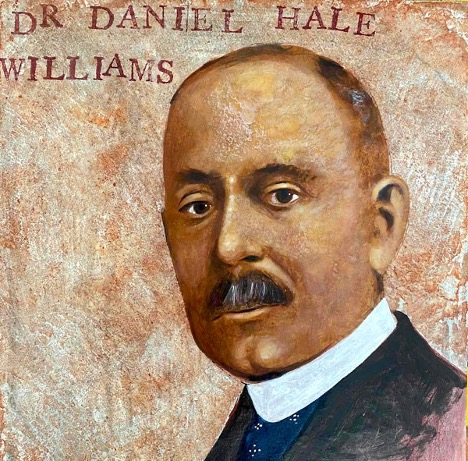
Dr. Daniel Hale Williams was one of only a handful of Black physicians practicing in the United States at a time when segregation shut Black doctors out of most hospitals. White hospitals generally denied Black physicians admitting privileges, and Black patients often received inferior care or were refused treatment altogether.
Rather than accept those barriers, Williams founded Provident Hospital and Training School in Chicago in 1891. It became the nation’s first Black-owned and operated hospital with an interracial medical staff and nursing school, creating opportunities that simply did not exist elsewhere.
On July 9, 1893, Williams operated on James Cornish, who had suffered a stab wound to the chest. During the operation, Williams discovered a tear in the pericardium—the protective sac surrounding the heart—and successfully repaired it. At the time there were:
- no antibiotics,
- no blood transfusions,
- no heart-lung machine,
- no X-rays to guide the surgery,
- and only rudimentary anesthesia.
Many surgeons of the era believed the chest—and especially the heart—should never be opened because death was almost certain. Williams proved otherwise.
Cornish survived the operation and recovered, living for many years afterward. The procedure is widely recognized as one of the earliest successful operations involving the heart and a landmark in the development of cardiac surgery.
Williams did far more than perform a historic operation. He spent his career dismantling barriers in medicine by:
- founding Provident Hospital, where Black physicians could practice and Black patients could receive quality care;
- establishing one of the country’s first training programs for Black nurses;
- serving as chief surgeon at Freedmen’s Hospital, where he modernized surgical training and patient care;
- helping found the National Medical Association in 1895 after Black physicians were largely excluded from the American Medical Association;
- becoming, in 1913, the first Black fellow of the American College of Surgeons.
The significance of this surgery
Williams’ achievement was not simply a surgical milestone. It was also an act of resistance against a segregated medical system. When existing institutions excluded Black physicians and patients, he built new ones—and in doing so advanced American medicine for everyone. His July 9 operation demonstrated that innovation and excellence could flourish despite the barriers imposed by racism, and it helped lay the groundwork for modern heart surgery.
Share now