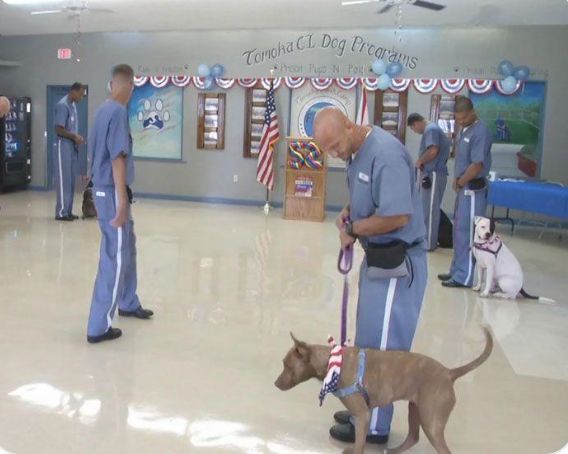
Across Florida, a growing number of prisons are partnering with animal shelters, humane societies and nonprofit organizations to bring unwanted shelter dogs inside correctional institutions, where incarcerated men and women live with them, socialize them and train them, making difficult-to-place dogs more adoptable while giving their human trainers useful skills and something remarkably scarce in prison: a chance to care for another living being.
.
Florida has been experimenting with this idea for years, and the programs have developed into a remarkable patchwork of partnerships rather than one centralized state project.
.
Among them are EPIC Pups at Jefferson Correctional Institution in Monticello; WOOF — Women Offering Obedience and Friendship; Prison Pups N Pals at Tomoka; ROCK Hounds — Rehabilitation of Castaway K-9s at Union Correctional Institution; T.A.P.S.; B.A.R.K.; Top Dog; and other institution-specific programs. The Florida Corrections Foundation maintains a statewide directory connecting individual institutions with the shelters and nonprofit organizations supplying their dogs.
.
These are not dogs brought in for occasional therapeutic visits. In several programs, the dogs actually live inside the correctional facility with their incarcerated handlers, receiving attention and training throughout the day.
.
Some programs are quite old. ROCK Hounds was operating at Union Correctional Institution by 2014, for example, taking abandoned, neglected and abused shelter dogs through a roughly 12-week rehabilitation and obedience program.
.
Tomoka’s Prison Pups N Pals was already nine years old by 2019 and had graduated 364 dogs by that point. Some graduates entered a related program pairing trained dogs with veterans. Incarcerated trainers could also earn certifications based upon their training hours—turning animal care into a potential employment skill after release.
.
And the idea is still growing. Monticello’s EPIC Pups is one of the newer programs. It partners Jefferson Correctional Institution with the nonprofit Jefferson County Humane Society/Wolf Creek Pet Adoption Center. Its first class graduated in April 2024 after dogs spent 16 weeks learning obedience and socialization from their incarcerated trainers. Four Wolf Creek dogs were adopted during that first year.
.
The economics are interesting as well. There isn’t one corporation financing Florida’s programs. They are generally collaborations among the Department of Corrections, individual institutions, shelters, charitable foundations and nonprofit animal-rescue organizations.
.
Historically, the Animal Welfare Foundation has been an important supporter. Corrections Foundation records show that by 2017 it had contributed more than $450,000 toward Florida prison dog-obedience programs and corrections K-9 activities. At that time Florida reported 21 programs in state institutions plus nine programs in private facilities and sheriff’s offices, with approximately 3,800 dogs trained and placed in homes and more than 3,350 incarcerated people participating.
.
Individual programs have their own nonprofit support. The TAILS program, for example, has been funded through the Jacksonville animal-rescue organization Pit Sisters and private donations.
.
And in Monticello, Wolf Creek itself receives no government funding and says it survives on donations and fundraising.
.
The appeal of these programs is not difficult to understand.
.
A frightened or poorly socialized shelter dog can enter prison unwanted and leave knowing how to walk on a leash, sit, stay, trust people and live in a home. A prisoner who is ordinarily told what to do every minute of every day suddenly becomes responsible for feeding, exercising, teaching and reassuring an animal completely dependent upon him or her. and gains new skills that can be used upon release.
Share now