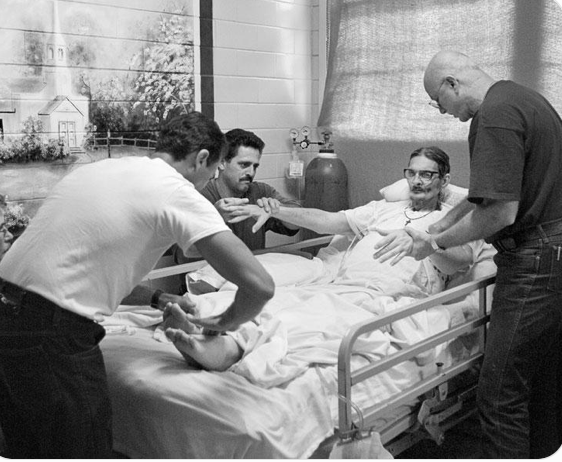
Inside Louisiana State Penitentiary known simply as Angola, incarcerated men volunteer to bathe, feed, comfort and sit bedside with terminally ill fellow prisoners, maintaining vigils through the final hours so that even a man condemned to spend his life behind bars does not have to die in prison alone.
It is one of the most extraordinary prisoner-run programs in the United States.
Angola established its hospice in 1997, admitting its first patient in January 1998. The reason was both grim and practical. Louisiana State Penitentiary housed thousands of men serving extremely long and life sentences, creating an aging population in which large numbers of prisoners were expected eventually to die inside the institution.
Under then-Warden Burl Cain, the prison worked with University Hospital Community Hospice in New Orleans to develop a program meeting national community-hospice standards. Outside hospice professionals supplied expertise, consultation, training and support, while prison medical personnel and incarcerated volunteers provided the care inside Angola. The original program was designed to operate without additional cost to the prison.
But it was the prisoners themselves who made Angola’s model extraordinary.
Prospective hospice volunteers undergo screening and training. Once accepted, they become caregivers to other incarcerated men approaching death. Research on Angola’s program describes volunteers helping patients with eating, bathing and everyday care, providing companionship and emotional support and developing the kind of continuous relationship that an overworked institutional medical staff cannot necessarily provide.
When death approaches, fellow prisoners can remain with the patient.
That simple fact matters enormously in a prison.
The program developed an interdisciplinary approach in which medical staff, corrections personnel, hospice personnel and incarcerated caregivers work together on individual patients’ needs—not merely pain and disease, but emotional, social and spiritual suffering as well.
Angola’s hospice became nationally influential. In 2000 it received the American Hospital Association’s Circle of Life Award, and its staff subsequently helped other correctional institutions develop their own hospice and palliative-care programs.
Its unusual financing is also worth noting. Historically, the hospice described itself as operating largely through donations and volunteer support, supplemented by ordinary prison medical resources. Award money and donations have paid for training, educational materials, medical supplies not otherwise available from the state and other program needs. Prisoners themselves even made quilts associated with the hospice, with the project becoming nationally known through the photographic documentary Grace Before Dying.
Outside support has continued to evolve. The Louisiana-Mississippi Hospice and Palliative Care Organization now provides education and technical support for incarcerated hospice volunteers and correctional professionals at Angola and other prisons. Its Prison Support Project has received support from charitable foundations and health organizations and continues to seek tax-deductible donations and grants for prison hospice education.
There is an important caveat. A 2026 discussion of Angola’s system argues that prisons can also become dependent upon unpaid or underpaid incarcerated caregivers to compensate for inadequate institutional care. Compassionate prisoner labor should never become an excuse for the state to neglect its responsibility to provide adequate medical treatment.
But that criticism doesn’t diminish what the incarcerated caregivers themselves are doing.
Fellow inmates are washing another man’s body, changing his bedding, bringing him food, listening when he is frightened and sitting beside him as his life ends.
Angola’s hospice has endured for nearly three decades because it discovered something punishment alone cannot produce:
Even in one of America’s most notorious prisons, people can still choose to care for one another and nobody has to die alone.