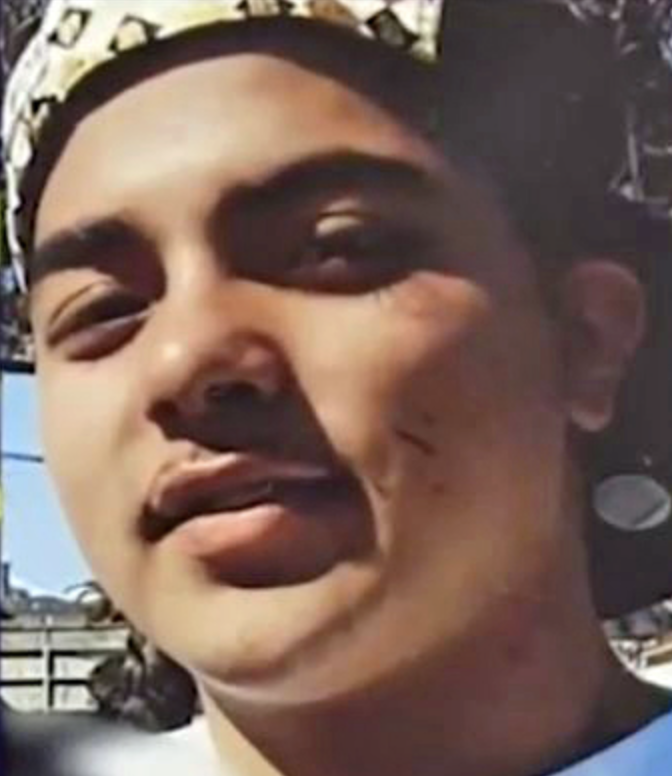
Michael Jonathan Cortez
Age : 30
Gender : Male
Race : Latino/a/e
Date : 09/13/2021
Location : 2585 Fruitvale Avenue, U-U Smoke Shop
City : Oakland
County : Alameda
State : California
Agency : Federal Bureau of Investigation; U.S. Marshals Service Task Force
Officer(s) :Not Disclosed
Cause of Death : Gunshot
Event : Killed by FBI agent during attempted arrest
OPEN RECORDS SUMMARY :
On 09/13/2021, an unidentified FBI special agent shot and killed 31-year-old Michael Jonathan Cortez inside the U-U Smoke Shop at 2585 Fruitvale Avenue in Oakland's Fruitvale neighborhood. The FBI agent was deputized as a U.S. Marshal and was participating in a regional fugitive task force attempting to arrest Cortez on federal and state warrants.
.
Cortez had gone into the neighborhood store to buy snacks and a drink. Store employees knew him as a regular customer. Surveillance video from outside the business showed an unmarked vehicle arrive and an agent run toward the store with his handgun already drawn. The FBI later acknowledged that only approximately eight seconds elapsed between the agent entering the store and shooting Cortez.
.
The warrants reportedly included two state warrants originating in Hayward involving domestic-violence and police-evasion allegations and a federal mail-theft matter. Hayward police later said that although their department had supplied information concerning Cortez, it had not specifically requested that the federal fugitive task force arrest him. The U.S. Marshals Service was conducting the operation, while the shooter was an FBI agent assigned to the task force.
.
The FBI alleged that the agent was clearly marked as law enforcement, identified himself, issued commands and attempted to arrest Cortez. According to FBI San Francisco Special Agent in Charge Craig Fair, Cortez attempted to move out of the store, came into contact with the agent, stepped backward and then allegedly pulled a .40-caliber handgun from a bag.
.
The FBI alleged that the agent believed Cortez presented an immediate danger and fired a single round. Cortez was struck in the torso and transported to a hospital, where he died. Cortez's girlfriend later said doctors told the family that the bullet passed through his right arm before entering his heart.
.
Witness and family accounts sharply disputed important portions of the FBI's narrative. Store personnel said the agent approached with a gun drawn so abruptly that people inside initially believed an armed robbery was occurring. A store employee and another man ran toward the rear of the business because they were frightened by the armed man entering the store.
.
The store operator said Cortez had simply been buying a drink and snacks immediately before the encounter. An outside surveillance recording showed the agent rapidly approaching the business with his firearm drawn, but did not show what occurred inside during the critical eight seconds.
.
Cortez's family disputed the FBI's allegation that he threatened the agent with a firearm. Their later federal wrongful-death lawsuit went considerably further, alleging that Cortez was unarmed at the moment he was shot, was kneeling in a surrendering position and did not pose a threat when the FBI agent fired.
.
The lawsuit also cited witnesses who said they did not hear the plainclothes agent identify himself or issue commands before entering. A friend waiting outside reportedly saw a person dressed in ordinary clothing run toward the store carrying what appeared to be a gun. The complaint alleged that the circumstances were so confusing that people at the store believed a robbery was underway.
.
The family's allegations directly conflict with the FBI's account that the agent identified himself, gave lawful commands and shot only after Cortez drew a handgun. Those competing accounts make the unreleased interior surveillance recording and complete investigative files central evidence in determining exactly what occurred during the approximately eight-second encounter.
.
The Oakland Police Department obtained surveillance video from inside the store as part of its investigation. In the immediate aftermath, however, authorities did not publicly release that footage. The store's security equipment was seized before the store operator could personally review the recording.
.
The shooting generated unusual concern within Oakland government because the person who killed Cortez was a federal agent operating inside the city rather than an Oakland police officer. Oakland officials subsequently held public discussions specifically addressing the presence of outside law-enforcement agencies and the mechanisms available for investigating their use of deadly force.
.
Oakland Police Commission proceedings subsequently confirmed that OPD treats a fatal use of force by an outside law-enforcement officer within Oakland as a Level One use-of-force incident for purposes of a local criminal investigation. Thus, there were effectively parallel accountability structures: Oakland police conducted a criminal investigation into the shooting while the FBI announced an internal federal review through its Inspection Division.
.
The federal arrangement raised a separate independence issue. The FBI publicly announced that its own Inspection Division was investigating a shooting committed by an FBI agent, even though that agent had been operating as a deputized member of a U.S. Marshals Service task force.
.
Transparency became a significant issue after the killing. Cortez's family repeatedly demanded the identity of the shooting agent and release of the store surveillance footage. Community organizations organized demonstrations calling for the FBI to identify the agent and release the evidence.
.
Oakland records show that public-records requests specifically sought the September 13 store video, Cortez's arrest warrants, records concerning Oakland officers deputized by federal agencies, and information about Cortez's arrest. OPD acknowledged locating responsive materials including a report, video footage, statements and photographs but initially withheld them under the active-investigation exemption.
.
The records dispute continued into 2022. OPD said its Criminal Investigations Unit would communicate with the FBI concerning the records. The continuing dispute is significant because it confirms that substantial evidence beyond the abbreviated public FBI account existed, including video, statements, photographs and investigative reports.
.
In March 2023, Cortez's family filed a wrongful-death lawsuit against the federal government. The lawsuit alleged that the FBI agent killed Cortez without reasonable justification and characterized the shooting as an execution. The complaint alleged that Cortez was kneeling and surrendering when the agent shot him and that he presented no immediate danger.
.
The FBI continued to dispute that account, maintaining that Cortez drew a firearm during the attempted arrest. Authorities reported recovering a handgun, an illegal magazine and additional firearm components from the scene. The presence of a firearm at the scene, however, is distinct from the disputed question of precisely what Cortez was doing with it at the instant the agent fired.
.
Later information provides an important development in the case. By 2026, reporting examining the difficulties local authorities encounter when investigating federal law-enforcement shootings stated that federal video evidence ultimately supported the agent's claim of self-defense and that no criminal charges were filed. That later evidence substantially strengthens the government's account compared with the limited information publicly available immediately after the killing.
.
Nevertheless, Cortez's case remains an unusually important federal deadly-force case because of the speed of the encounter, the plainclothes agent's armed approach, the conflicting initial witness accounts, the family's subsequent wrongful-death allegations, the withholding of evidence during the active investigation, and the unusual overlap between an Oakland criminal investigation, a U.S. Marshals fugitive operation and an FBI internal shooting review.
.
OFFICER BACKGROUND
The FBI special agent who shot and killed Michael Jonathan Cortez has not been publicly identified in the records located for this update.
SOURCE LINKS :
https://www.sfchronicle.com/crime/article/Oakland-FBI-shooting-Fruitvale-16465033.php
https://www.nbcbayarea.com/news/local/east-bay/fbi-agent-shooting-oakland-fruitvale/2660184/
https://oaklandside.org/2021/09/14/fbi-agent-shooting-oakland-fruitvale-avenue/
https://www.mercurynews.com/2021/09/14/fbi-agent-fatally-shoots-man-in-oakland/
https://abc7news.com/jonathan-cortez-oakland-fruitvale-fbi-shooting/11091764/
https://www.ktvu.com/news/lawsuit-against-fbi-alleges-oakland-man-was-executed-in-2021-shooting
https://www.theguardian.com/us-news/2021/oct/30/jonathan-cortez-fbi-shooting-oakland
https://www.kqed.org/news/11888796/we-just-dont-understand-family-and-friends-of-man-killed-by-fbi-inside-oakland-store-hold-vigil
https://www.ktvu.com/news/family-identifies-man-fatally-shot-by-fbi-agent-in-oakland
https://abc7news.com/jonathan-cortez-oakland-fruitvale-shooting/11086205/
https://www.ktvu.com/news/man-shot-and-killed-by-fbi-in-oakland-allegedly-drew-a-gun-agents-say
https://oaklandnorth.net/2021/10/16/oakland-cortez-fbi-shooting-rally/
https://www.latimes.com/california/newsletter/2021-09-20/fbi-shooting-east-oakland-michael-cortez-essential-california
https://oakland.legistar.com/MeetingDetail.aspx?GUID=982F2C16-0D75-4615-978B-C0B60AB9163C&ID=895936&Options=&Search=
https://www.sfchronicle.com/crime/article/ice-kills-bay-area-investigate-21286581.php